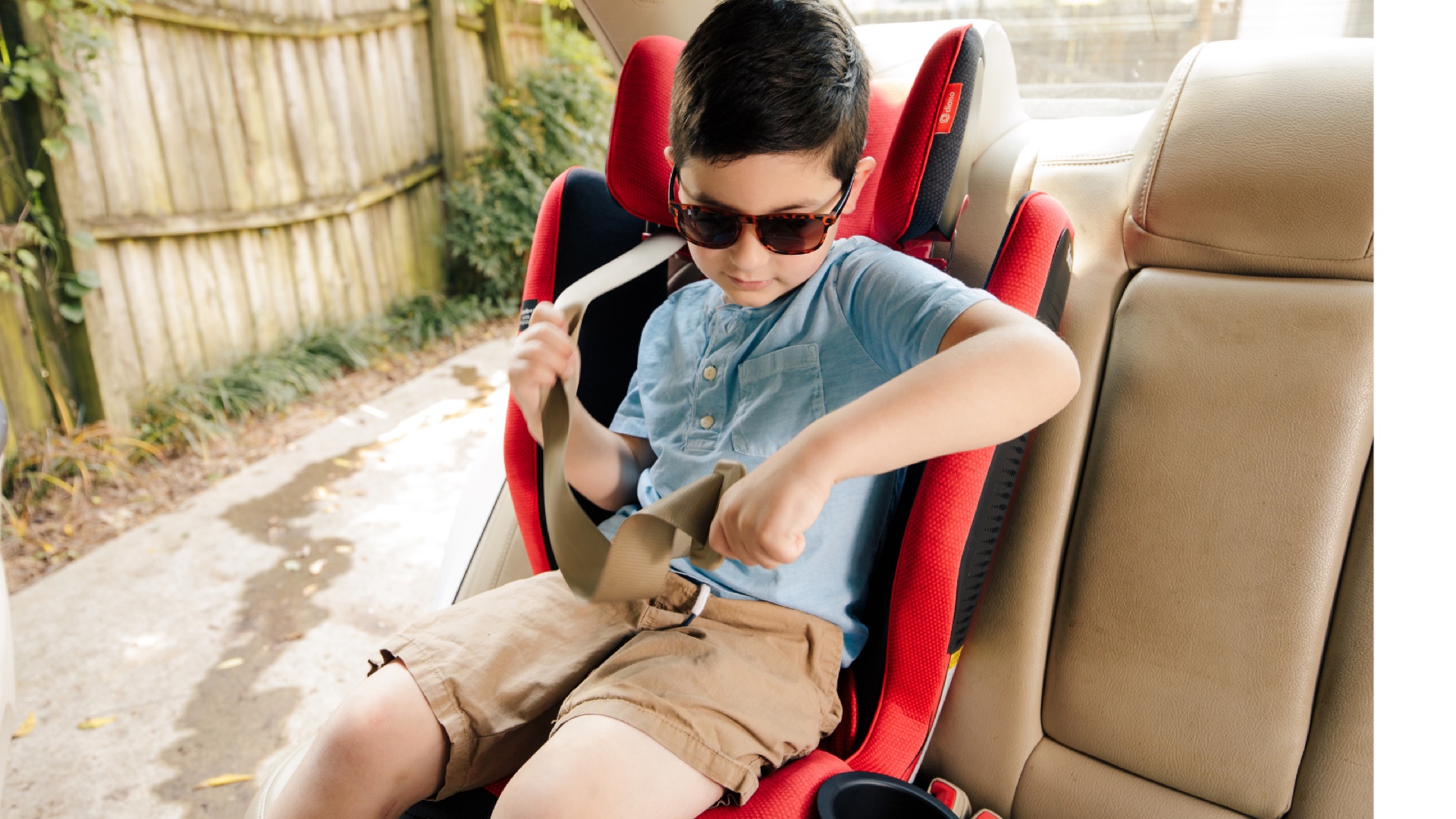
Every year before school starts, I ask my Instagram community one question: "What's stressing you out most about back-to-school?" This year, tons of parents answered, and honestly, the responses were almost identical.
They weren't asking about perfect lunchbox ideas or first-day outfits. They were worried about getting everyone out the door, whether their kindergartener would survive carline, if their child is ready for a booster seat, and whether riding the bus is actually safe. So let's answer the biggest back-to-school questions parents are asking this year.
If you want practical, judgment-free car seat and safety tips throughout the year, not just during back-to-school, join our email community. I'll send you the same advice I share with parents every day.
01 · Fewer decisions before coffee
"How do we actually get out the door on time?"
Can we all agree the hardest part of school mornings isn't school, it's getting everyone out the door?
Somebody can't find a shoe. Someone suddenly remembers a permission slip. The water bottle isn't filled. You're trying to brush your own teeth while answering fourteen questions before 7:30.
Most chaotic mornings don't actually start in the morning. They start the night before. Every decision you make tonight is one less decision your tired brain has to make tomorrow. Lay out clothes. Pack backpacks. Fill water bottles. Put shoes by the door. You don't need a Pinterest-worthy routine. You just need fewer decisions before coffee. School mornings may never be perfect. But they can absolutely be easier.
Make it easier for toddlers to succeed
Little kids don't understand "hurry up"
One thing I learned as a mom? Little kids understand visuals and games. Visual timers help them see how much time they have left. Routine charts help them know what's next without you repeating yourself twenty times.
If getting dressed is a daily battle, sometimes you have to pick your battles. My rule was simple: you need to be wearing something clean, and you need to have underwear on. Everything else? If the socks don't match or today's outfit is a little...creative...that's okay. I'd rather save my energy for the things that actually matter.
Routines don't have to be perfect. But removing a few decisions can make mornings dramatically easier.
02 · Practice the whole sequence
"How do I prepare my child for kindergarten carline?"
This was one of the most common questions from our community this year. If this is going to be your first kindergarten carline, for you and your child, listen up.
You may not have even realized it yet, but gone are the days of parking, walking your child into school, and making sure they get where they need to go. Now you pull up, they hop out, and you drive away. And if that thought makes your stomach do a little flip, you're not alone. I promise you won't be the only parent white-knuckling that first drop-off.
Here's the real worry underneath all of it: it's not really "is carline safe," it's "what if we're the car that holds up the whole line because my kid doesn't know what to do?" Totally fair. Nobody wants to be that car.
Here's what almost no one tells parents: kids aren't just expected to know how to do carline. It's a skill. And just like any other skill, we can practice it in the right order.
- 1
Prep everything else first
Figure out which side of the car your child will be getting out on, and make sure the car seat is actually installed on that side. Nothing slows down a line like realizing mid-drop-off that you buckled them in on the wrong door.
- 2
Then prep your child
Practice the individual steps: unbuckle, grab the backpack, open the door, hop out, close the door.
- 3
Role-play the whole thing
A few days before school starts, run the entire routine in your driveway or an empty parking lot. Practice the complete sequence like it's the real thing.
Five minutes of practice won't just make carline smoother. It'll make both of you feel more confident on that very first morning.
And because I know someone's thinking it: "Couldn't we just skip all this and put her in a booster so unbuckling is faster?" I get the instinct. But no, she still needs to be in whatever seat she's actually ready for, even if it takes an extra few seconds in carline. Carline speed is never a good enough reason to move a child into a seat before they're ready for it.
Helpful products for kindergarten carline
Make independence easier
- UnbuckleMe: a tool that helps kids unbuckle themselves.
- Backpack: easy for little shoulders to carry.
- Backpack tags or name labels: if your child is starting school for the first time, label everything: water bottles, lunch containers, backpacks, and jackets. You'll thank yourself later. I love labels that survive the dishwasher, microwave, washer, and dryer, and parents tell me they last the entire school year.
- Lunch box: one your child can carry independently.
"I thought we'd be the car holding everyone up. We practiced twice in the driveway and my daughter hopped out like she'd done it for years."From another mom
03 · Readiness is not a grade level
"Is my child ready for a booster?"
I've gotten more booster seat questions this week than almost anything else. Maybe you're standing in Target wondering if your child is ready. Maybe Grandma says they don't need a harness anymore. Maybe another parent says, "Mine switched at four." No wonder you're confused.
The biggest misconception is that booster readiness is about age or grade. It isn't.
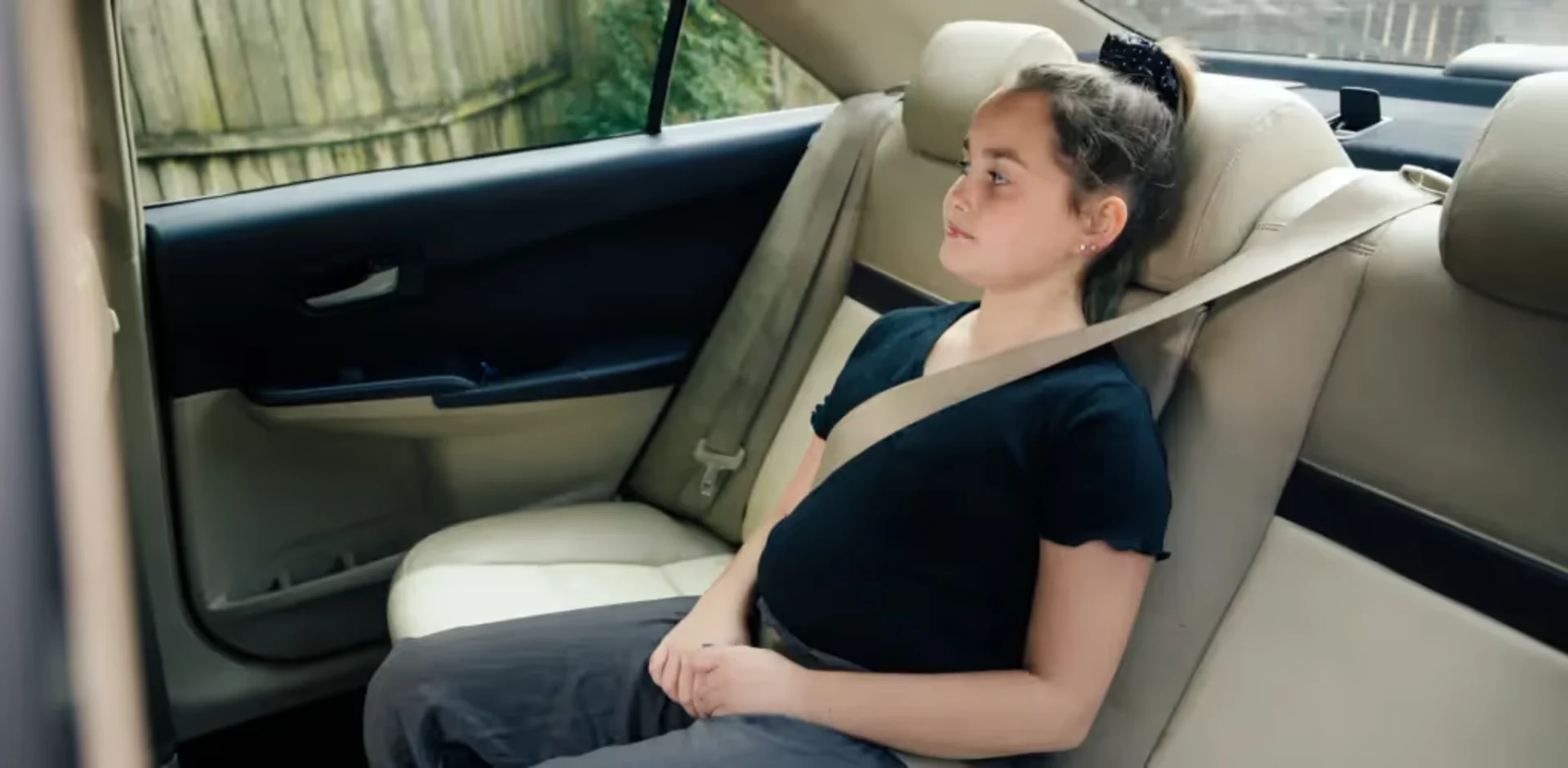
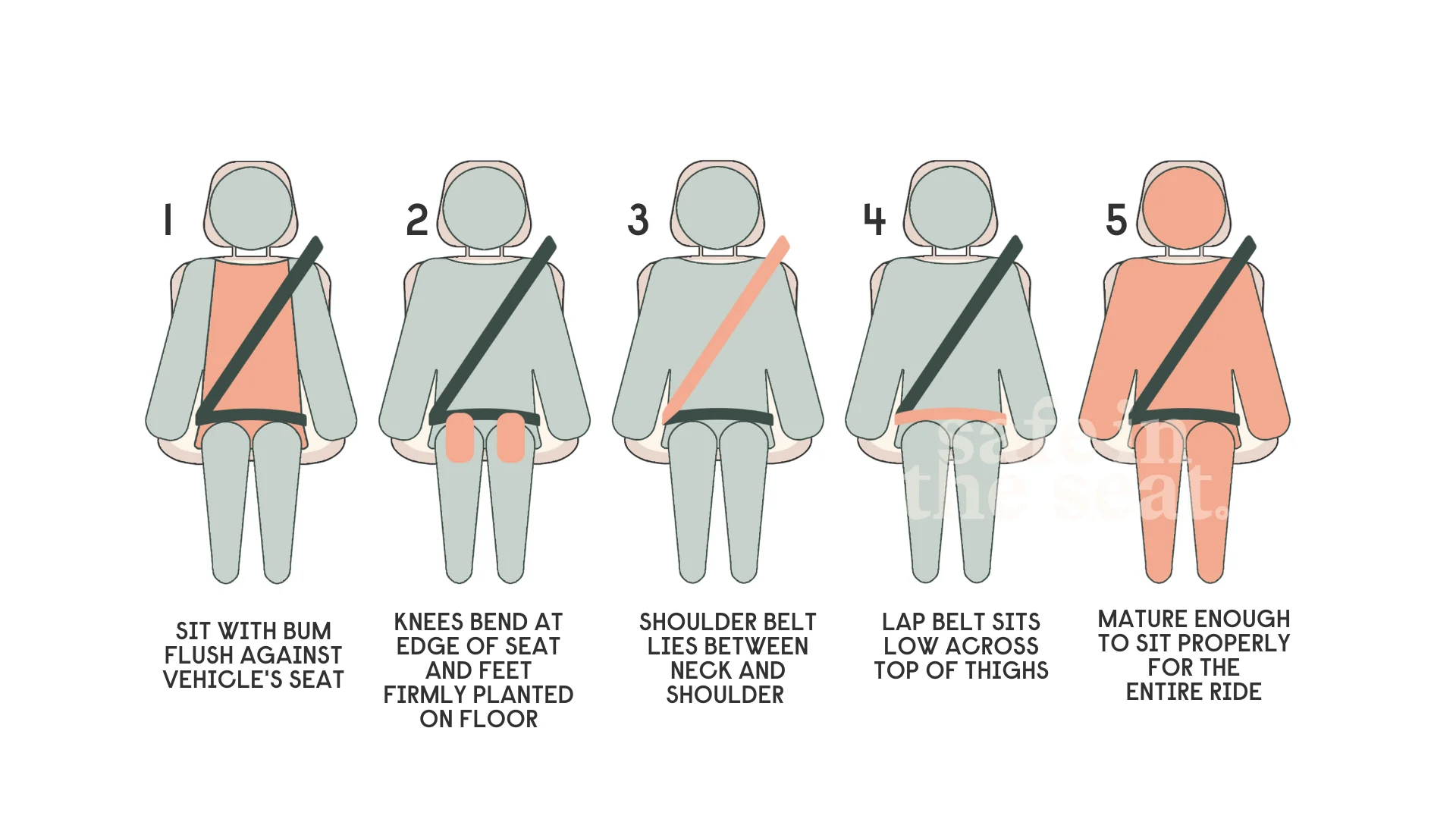
Here's the shift most parents miss: in a harnessed seat, the seat is doing the work. It restrains your child and holds them in the correct position. In a booster, your child can move, and it becomes their job to sit properly on their own. That's the real test of readiness, not a birthday or a grade.
Safe
Meet the minimums
Move your child to a booster seat once they meet the minimum requirements of that specific seat.
Safer
Move past bare minimums
Wait until they are past the booster's bare minimums but have not yet maxed out a limit of their current harnessed seat.
Safest
Max out the harness
Wait until your child reaches a height or weight limit of the harnessed seat they currently ride in. Maturity matters too. I generally lean toward maxing out the harness when possible, and age 5 or older as a starting point, never a birthday or grade alone.
If they can't consistently sit correctly for the entire ride, they're probably not ready yet. There isn't a magic birthday that tells you it's time. Your child's behavior tells you when they're ready.
If your child isn't ready for a booster, look for a forward-facing seat with higher limits, like the Chicco MyFit. Beyond this, you can also meet with a CPST for personalized guidance.
Still wondering if your child is booster-ready? Read my complete guide on booster readiness and the milestones that actually matter.
04 · Confidence on and off the bus
"Is the school bus safe?"
Nervous about the school bus? You're definitely not the only one wondering this. If your child is riding the school bus for the first time this year, I know your brain has probably imagined every worst-case scenario. Will they know where to sit? Will another kid be mean? Will they miss their stop? Are they actually safe?
Every first-time bus parent has wondered those things. Letting your child ride the bus for the first time is a much bigger milestone for us than it is for them.
What might surprise you
The bus itself usually isn't the part I worry about most. The bigger safety lessons happen outside the bus.
Teach your child to wait where the driver can see them. Never walk behind the bus. Cross only after the driver signals it's safe. Those simple habits make a huge difference.
And if your worry isn't really about the bus itself but about who's on it, that's completely valid too. Bullying and exposure to older kids is, without fail, the thing most people bring up any time we talk bus safety. Prep for that side of it just as deliberately as you'd prep for the physical stuff:
- Talk to your child ahead of time about what to do if another kid is unkind. Give them the words to say no and walk away.
- Practice it. Role-play a couple of scenarios so "advocate for yourself" isn't just an abstract idea when it's actually happening.
- Make sure your child knows to tell the driver every time, right when it happens. Bus drivers are trained to protect the kids on their bus. It's not tattling, it's exactly what the driver is there for.
If your child walks to the bus stop before sunrise, consider adding reflective gear to their backpack so they're easier for drivers to see.
It's completely normal to be nervous. Knowing what actually matters on the bus and off helps replace fear with confidence.
Read the complete Bus Safety Guide05 · A 20-minute reset
"What should I keep in my car?"
Can I share something almost nobody thinks about before school starts? Getting your car ready. The first week hits. Someone skins a knee. Someone spills yogurt. Everybody's starving after pickup. You need tissues, wipes, sunscreen, and of course, none of it's in the car.
The goal isn't a perfectly organized mom car. It's removing tiny stressors before they happen. The essentials I always keep on hand: wipes, tissues, hand sanitizer, sunscreen, a few snacks, water, and a basic first-aid kit. These are the things you'll actually reach for over and over.
Get your car school-ready in 20 minutes
Spend twenty minutes setting it up now, and future-you will be so glad you did. Here's what I actually keep in my car during the school year, and why each one earns its spot:
Car vacuum, duster, and screen cleaner: a five-minute reset at the gas station or in carline.
Resqme and flashlight: emergency tools, plus a flashlight for the phone that fell between the seats.
Jump starter and air compressor: independence and confidence if the battery dies or a tire goes flat.
Trunk organizer and mesh zipper bags: keep extra shoes, sunscreen, bug spray, and a travel potty contained.
UnbuckleMe: useful for carline and caregivers who may have trouble managing the buckle.
Mini first-aid kit and emesis bags: for surprise scrapes and sickness.
Car tissues: something you never think of but always need.
Wet/dry bags: for potty accidents, spare clothes, or unexpected water at the park.
Center console organizer: for eye drops, cables, Advil, a protein bar, and a Tide stick.
Soft caddy: fill it with grab-and-go snacks for pickup.
Reusable bags, emergency poncho, and portable charger: the final layer for whatever the week throws at you.
06 · Independence beats perfection
"What's actually worth buying for school lunches?"
You pack the cutest lunch. Then it comes home untouched, or soggy, or leaking, or your child couldn't even open the container. The best lunch isn't the prettiest one. It's the one your child actually eats.
The lunch hack that's actually worth your money
The internet loves lunch hacks. But most of them don't survive a real elementary school day. I look for containers little hands can open independently, foods that stay fresh until lunch, and a lunchbox that actually keeps food cold. Simple almost always wins. You don't need a viral lunch. You just need one your child can enjoy.
Rather than the cutest lunch products, I look for products that make independence easier. My favorites include:
- Lunchbox
- Easy-open containers
- Leakproof snack containers
- Water bottle
- Ice packs
- Thermos
- Reusable snack bags
Before the first day of school, have your child practice opening every container you'll pack. If they can't open it at your kitchen table, they probably won't be able to open it in a noisy cafeteria. That's a great tip parents don't usually think about.
07 · To the first-time kindergarten mom
"What if I'm not ready to send my baby to kindergarten?"
This one's for the mom sending her first baby to kindergarten. You've spent weeks buying supplies. Labeling everything. Practicing names. Packing backpacks. But somehow, no one prepared you for the emotions. Because one minute you're excited for them, and the next you're sitting in your car wondering how they got this big.
Here's what I want you to remember. Nothing about today means they need you less. It just means they're ready for something new. There may be tears. Maybe theirs. Maybe yours. Maybe both. But kids are incredibly resilient when they know they have someone cheering them on at home.
So if you cry after drop-off, know this: you're in really good company. We've all been there. And I promise, you're both going to be just fine.
"Nobody told me how emotional kindergarten drop-off would be. I cried the whole way home."From another mom
The community asked. She answered.
Michelle's Take

Real answers for the parts of back-to-school that don't fit neatly on a checklist.
How do other moms schedule time for gym or exercise when, in any spare moment, all I want is sleep?
First, this is a season. Not every season has time for the gym. Not every mom has the energy for an at-home workout. Not every mom has help or other hands to give her that time away. So don't make it about a gym or workout class. Make it about movement.
In the early years especially, that movement often needs to be done with the kids. Those walks count. Throw in a walking lunge if you're feeling especially energetic. Lift your kid up and down ten times, ground to above head. Isn't mommy fun? When you can see a way to carve out dedicated exercise, it will be obvious. If you're asking this question now, then you just may not be in the gym season, and that's okay. Movement is all around us.
Things you wished you'd known as a kinder mom?
My first had to do kindergarten from our house because it was during Covid. That was fun. I think I would say don't take things too seriously. Milestones are on a continuum. Don't overly focus on them or get panicked if your kid writes their letters backward.
The other biggest thing: your children are not your report cards. You're a good mom. Full stop. Don't let their learning or behaviors be how you judge yourself as a mom. This can be easy to do. Call that thought in your head a name, I like Betty, and when Betty starts telling you that you should be ashamed or should have done something different so your kid didn't knock over everyone to get to the front of the lunch line, tell Betty to F off.
Traditions for the first day
When my kids were younger, we would role-play in the morning the week before. Pick out our timer, songs, breakfast plans, and finalize the chart. In our house, it is a tradition to prep ahead, and I swear it's the key to smoother mornings.
Have a plan and get everyone on board with how it's going to go. Dry run that baby a few times before the big day. It still won't be perfect, but people can't meet expectations if they don't know what they are. We do first-day pictures, but often not on the first day. If we do a full dry run, I'll take their pictures that day. We have a little chalkboard they fill out that I got at Michael's more than ten years ago. If I'm really on it, I do a little banner or tablecloth. Dinner is spaghetti. They know exactly what to expect on the first day of school.
Tips for the emotional fallout after school?
Time and space. Don't drill your kids with questions when they get in the car. If you ask anything, let it be: what made you smile today? What friend did you do something nice for? How did you include someone who was left out?
I have a snack prepped. On days I don't do it, I regret it terribly. It sounds simple, but it always has a protein, fat, and carb. My kids are older, so now, if they follow the morning chart without prompts and we leave on time, they get to choose what they do after school for 45 minutes. Play, watch a show, whatever. When they were younger, it was more of the same, but guided and more dependent on me.
One thing I always do too: we talk about the day at breakfast. I try to know what we are having for dinner so they can wrap their brains around that. I go over any must-dos that afternoon, whether it's a doctor's appointment, a library book, or something else. I also ask what's on their mind. My son may say he wants to go to Home Depot and build a shelf. I'd rather know what plans he has in his head and reroute the thinking in the morning. When I pick them up, I review the afternoon again. After some chill time, then it's physical activity of some kind.
Tested by a CPST and a mom
Shop My Back-to-School Favorites
I've tested dozens of products over the years. These are the ones I reach for every school year.
Carline & car organization
- Car organizer
- Trash can
- First-aid kit
- Wipes
- Hand sanitizer
Lunch
- Lunch box
- Containers
- Water bottle
- Ice packs
Morning routine
- Visual timer
- Routine chart
- Labels
- Backpack
Quick, practical answers
Back-to-School FAQs
How do I make school mornings less stressful?
The easiest way to simplify mornings is to make fewer decisions in the morning. Pack backpacks, lay out clothes, fill water bottles, and prep lunches the night before. Your routine doesn't have to be perfect, it just needs to reduce chaos.
How do I prepare my child for kindergarten carline?
Practice the entire routine before school starts: unbuckle, grab their backpack, open the door, get out, and close the door. Running through the full sequence at home helps your child feel confident on the first day.
Should my child unbuckle while we're still moving in carline?
No. Children should stay fully buckled until your vehicle has come to a complete stop. Once stopped, they can unbuckle, grab their backpack, and exit safely.
Should I switch my child to a booster seat just to make carline easier?
No. Carline convenience should never determine when a child moves to a booster. Your child should stay in the seat that's appropriate for their size and developmental readiness, even if it takes a little longer to unbuckle.
When is my child ready for a booster seat?
Booster readiness isn't based on kindergarten, age, or grade. It's based on size and maturity. A child must be able to sit correctly for the entire ride without leaning, slouching, or moving the seat belt out of position.
Is the school bus safe?
Yes. School buses are one of the safest ways children travel. The biggest safety lessons happen outside the bus. Teach your child to stay where the driver can see them, never walk behind the bus, and only cross when the driver signals it's safe.
What should I keep in my car during the school year?
Focus on items you'll actually use: wipes, tissues, hand sanitizer, sunscreen, snacks, water, a first-aid kit, and emergency supplies like a jump starter or flashlight. Preparing your car now can make everyday pickups much easier.
What lunch products are actually worth buying?
Choose products your child can use independently. Easy-open containers, a lunchbox that keeps food cold, leakproof containers, and a water bottle they'll actually drink from are more valuable than trendy lunch gadgets. Practice opening everything before the first day of school.
Should my child wear their backpack while buckled in the car?
No. Backpacks should always come off before buckling. Shoulder straps under a harness or seat belt can change how the restraint fits and reduce its effectiveness in a crash.
When can my child ride in the front seat?
Children should ride in the back seat until at least age 13, even if they seem tall or mature for their age.
You don't have to figure this out alone
Know what actually matters
Whether your child is starting kindergarten, moving to a booster, riding the bus for the first time, or heading into middle school, we'll help you know what actually matters without spending hours second-guessing yourself.
Join thousands of parents getting practical safety tips every week.
- Stage-specific advice
- New safety updates
- Product recommendations we actually trust
- Judgment-free guidance from birth through age 13
About the author
Michelle Pratt, CPST
Michelle is a nationally certified Child Passenger Safety Technician, mom of two, and founder of Safe in the Seat. She helps caregivers cut through car-seat confusion with practical tools, expert guidance, and zero judgment.
Meet MichelleYou've got this.